Blog

Thursday, 13 July 2017

R.I.P. Tommy Simpson 1937-67 (died July 13, stage 13 of the Tour, Mont Ventoux)

Something of Simpson's happy-go-lucky
character is communicated here
Tommy Simpson died 50 years ago today

It's fifty years today since Tommy Simpson died on the Ventoux on the 13th stage of the 1967 Tour, so I thought I'd just put up this simple post to honour him.

In William Fotheringham's excellent book Put me back on my bike, which was published in 2002, he makes a stray comment to the effect that Simpson paved the way for other non-Continental riders to succeed at a quintessentially continental, mainland European activity: professional road racing.

Fotheringham then mentions Lance Armstrong at a time when we didn't know for sure that he'd doped.

At a later remove I'm sure Fotheringham would have also mentioned Wiggins.

The irony of course is the doping, perhaps adding a coda in the form of therapeutic use exemptions and jiffy bags.

Simpson was spending the equivalent of four year's wages on a single season's amphetamines, going after what was considered at the time to be the Rolls-Royce of amphetamines, Tonedron. On the day he died he had three ampoules in his jersey pocket, two and a half taken. He'd drunk cognac to dull the pain of an upset gut, and probably Coca Cola earlier on a big stage in high Provencal heat. All these substances de-hydrated him, on the back of having had diarrhoea for three days. In the massive heat as he came up the final sections of the mighty Ventoux, when above the tree line it becomes blinding white stone and a sun-baked oven of scree, his body signalled enough and he began to weave. Helped back on he continued for five hundred metres before collapsing forever from exertional heatstroke, greatly exacerbated by dehydration and by the drugs and alcohol. His fingers had to be prised off the handlebars and he was completely dry to touch. His team member was convinced that he had died on the bike. In any sense except the clinical, I think that's probably true. His death takes its place in a long row of completely avoidable British deaths in the 'amateur' pursuit of something crazy. Donald Campbell had died earlier in the same year in January 1967, pursuing a speed record on Lake Coniston.

And yet there is so much to admire. Simpson was as obsessed about his diet and his training and in fact every single aspect of his life, in pursuit of victory. Doping was merely his reluctant (but inevitable, and wouldn't we have done it in his shoes?) acceptance of what was rife among virtually all European riders at the time, as indeed it has been since for so many others. He was careless about his own well being when it came to winning but he was a brilliant rider and a brilliant winner. He also paid the ultimate price for winning at any cost, which leaves a question mark that we all have to answer for ourselves.

I timetrialled Ventoux on Monday June 26, 2017, with some other
journalists, wearing Simpson's team cap as a mark of respect. The recently renovated memorial to Simpson
was completely free of the normal clutter of bidons and caps, possibly because anything left there is blown
away by the wind, or because it is finally being managed.*
*Thanks to BMW UK and Rapha Travel for making this trip happen.

Thursday, 15 June 2017

PREVIEW: Switzerland’s New Eroica, The Bergkönig, Aug 26-7, 2017

Switzerland is joining the vintage cycling fray with The Bergkönig, a vintage cycling festival to be held for the first time in the village of Gstaad on the weekend of 26-27 August, 2017. 

The quality of light in the high Alps transforms everything
Read on for detailed notes about the course, which we are the first to ride on an old steelie, and a preview of the event and how to get there. Websites and contacts at the end.

Think L'Eroica ('The Heroes')– Italy’s runaway success, where only pre-1987 steel racing bikes are allowed. First held in 1997, L'Eroica has spawned a whole movement. The Eroica brand has been leased by its owners to events in Spain, the US and the UK, while standalone rides such as the Retro Ronde in Belgium and La Superba in Italy have become popular. The largest event is estimated to be Eroica Britannia, held in mid-June in the UK's Peak District. 40,000 visitors attended it in 2016. 

Bergkönig founder and Swiss vintage bike collector Alex Beeler and his wife Francesca (+41 79 217 62 04) are now launching the Swiss Vintage Cycling Festival. It will offer a vintage bike market and events and rides in the village of Gstaad, over the weekend of August 26-27, 2017. The whole focus of the Bergkönig will be on friendly, non-competitive, family fun. Numerous rides are offered, several of them just 20kms in length, to encourage the widest possible participation on even the most fragile machines. These rides, up to 85kms in length, are collected under the title Pedaleur du charme, the nickname of Swiss race legend Hugo Koblet (1925-64). However, make no mistake, the defining ride is the namesake Bergkönig-Ronde which translates 'King of the Mountains Loop', and which takes place on the Sunday.

COURSE NOTES: Bergkönig, 103kms, 2,400 metres climbing
Only 2% of the course is gravel; but the roads are often quite bumpy and technical. Freshly serviced brakes are essential. The ride breaks down into three sections that could be termed ‘beauty’, ‘beast’ and ‘bliss.’ The beast section is the meat of the event and roughly comprises four climbs, the second and fourth of which will define your memory of the event for reasons that we’ll come to. Look at the profile:

No points for spotting the painful bits
You set off from Gstaad the village (it’s also a region in the Canton of Bern). Ahead is a fantastically pretty schlepp down a valley on country lanes, with one particular back road that you turn left in to by the church in Rougemont. It's got the odd kick-up but as the profile shows, overall you're losing altitude. Now is the time to shake out your legs and get the feel for whatever bike you've got. In my case I was on a bike I'd only ridden that morning, and I was gingerly plying the six speed cassette; remembering that riding on the hoods is for sissies (they are not comfortable because hands were not meant to perched on them); wondering if the slightly short (for me) top tube/stem combo was going to be a deal-breaker or merely a minor detail (the latter, thankfully), and wondering with trepidation at the hard-man gearing, the lowest ratio 42x26. 

I was also busy figuring out where I was going, with only a map and some verbal instructions, but I can say that this is essentially a bulletproof ride. It takes advantage of a mosaic of already well sign-posted bike routes. The handful of critical turn-offs will be amply signposted on the day and I'd be most surprised if anyone goes off route through error. The circular nature of the route is also welcome, making logistics easy.

The first 25kms of the ride, all the way down to the turn at Montbovon, is easy streets. It's also Swiss beauty to die for and unless it happens to be pouring with rain you'll see bell-ringing cows, tiny high-altitude wild flower meadows and woods, and a mosaic of farmhouses, machinery and dogs and cats and birds in abundance. If it doesn't break into your inner-Swiss, something will have gone wrong. 

At Montbovon there is a crucial turn that you won't miss, and here is where the ride proper begins. Immediately you're climbing, and while there are respites, you are now gaining altitude for the next 18 kms to Lac de l'Hongrin, a huge reservoir high up in the alps. 

The ride proper begins here with an 18km climb to Lake Hongrin
Lac de l'Hongrin marks the end of 18kms of climbing
This is a lovely climb through woods. There are respites, but as you exit the trees it kicks up and suddenly you're aware of the residual rolling resistance of a back tyre deliberately left at 85psi instead of 100 +, to reflect the often fidgety surfaces of these roads. You're fully at work and if it's hot, you'll be aware of that too.

On reaching the dam you're off down the side of the lake now, all very lovely. 

You turn back down the other side at a military base marked by a tank. The roads here are wide and sweeping, the bridges numbered for tank manoeuvres. You're high up and the light dances, yet you're about to go up much higher still...

Can't miss this one


Towards Mont Blanc, from the summit of Pierre du Moëlle, 1,650m. 
...And so a sign appears pointing left to Pierre du Moëlle. This is the bit on the profile around the 50kms mark, where steady climbing points skywards and suddenly gets much steeper. This is where you're at 100% effort for the first time, and indeed I quickly found myself having to weave across the road from side to side to keep moving in a 42x26 ratio. The sharply cut drainage channels now become a hazard, because if you were to accidentally converge with one it would swallow your wheel and quite possibly end your ride there and then. Now's the time to grit - but stop and pause or walk if you need to. Lots of riders will need to. 

The view at the top is incredible, and is followed by a pretty technical descent where a healthy dose of caution is advised, not least because the road is so narrow. At the base of the descent you arrive at a main road where you'll be grateful to turn left and have a more normal gradient and a billiard ball smooth surface - but you've got another climb of over a kilometre before turning right towards Les Voëttes. More climbing here, this being the third of the climbs and on the profile the smaller 'hump' in the middle. Another descent and then some smooth road again to the ski station of Les Diableret. 

Here in Les Diableret there is another critical left turn and, I anticipate, a feed station, because the biggest climb lies immediately ahead, 7 kms of unrelentingly steep ascent. The day I did this it was 27 degrees centigrade - not as hot as it can be - and I was tiring. The heat beat relentlessly off the rocks and all I can say is that 4/5th of the way up you pass a couple of houses on a hairpin bend, and there in front of you is a mountain trough full of sparkly clean icy cold water. I stopped and immersed my whole head in it, tipped water down my neck and refilled my bidon. Take stock: you have about 1km to go so it's going to be OK.


Road to Iserau: this is your salvation if it's hot


Road to Iserau. This is the 4th climb of the event, also the hardest. You won't see this view because you're eyes will be full of sweat.

A kilometre beyond and, as Alex put it, 'at Iserau you're done: it's all over.'

Swiss fizz made from milk whey. Delish.
Cycling fare perfecto. Alp cheese, real bread and wafer thin meats 


Actually its not. You've got 35kms left to savour. The initial descent is as technical as ever and be careful not to overdo it across the cattle grids as I did, hitting one so hard I slightly threw the rear wheel out of true. When you reach the junction with the main road you turn left and the sign posts are once more for Gstaad. Now you've got billiard ball surfaces again and a fast, beautiful ride that flatters everyone because it's downhill even though it may not look it. Presently you reach the start/finish and hopefully a hero's welcome. Timingwise I took 5 hours 45 min, but including stops and quite a lot of iPhone mapping checks, I was actually on the road for nearly 8 hours - a 9 to 5 'long day in the saddle'.  In order to enjoy the stops, the views and the atmosphere you may find yourself doing likewise. View it as a lovely long day out and savour every moment.

By way of a summary note,  I think this was one of the finest rides I've experienced in recent years. It's not only ravishingly beautiful, to the point where if you're from the UK you'll bitterly regret it, but it's got grit and a sort of material distinction and charisma that is rare. Not seeing a single piece of litter from start to finish is also a first.

Regarding the vintage bit, I found myself increasingly appreciating a heavier but somehow purer, GIOS-built Colombus SL-framed mid-eighties race bike, in this case equipped with Dura-Ace 7400. It belongs to Alex Beeler, the organiser, and was the first generation bike to feature Look-style cleated pedals (which scrape in as allowable, according to the rules), although I rode it with Quoc Pham shoes (the Fixed model) and clips and straps. 


Weros is a local bike shop that sponsored an elite team in the 80s

The basic rule is steel bikes up to 1986, but the organisers are not going to quibble if you get a detail wrong. There is more information on components on the German-language version of the website. Kit-wise I have two lessons to share: 
1. the ideal tyre is 700x25, and for me the perfect contender is the Continental GP Four Seasons because of it's supple ride but strong cut protection. 
2. Get the gears...Old school gearing is going to hurt you on this course, but if you can ride most of it and walk a little, you'll feel you've had a unique experience compared to a modern bike. I was surprised how much I loved the older bike and a return to the downshifters I started on as a teenager. 


Organizers Alex and Francesca Beeler with their period
Toyota Camry 2.0 XLi Sportswagen,
equipped with an ex-Proteam bike roofrack
Accommodation, Travel Notes, Contacts
There is a wealth of information and the registration form at 
www.bergkoenig-gstaad.com. The cost of riding is Chf 100, about £75 at current exchange rates. The easiest way to get there from the UK is to fly to Geneva and then take a train to Montreux, changing onto the panorama 'Goldenweg' train that then climbs brilliantly towards the sun-lit Bernese Oberland. Alex's direct contact is alex@marketing-goetti.ch / +41 79 217 62 04 and he can advise on bikes and bike rental if you don't have one. We stayed at the Hotel HUUS above Saanen, the adjacent village of Gstaad. This is a cool, recently-opened, sporty chalet-style property boasting a wide range of summer events and activities all included in the price - very well worth considering if you would otherwise pay for those activities (everything from yoga to rafting - budget £200 per night). This four star property also has a very relaxed electro-beat DJ vibe and its own fleet of mountainbikes which you can simply take if you just want to whizz down the hill to the village. Of course there are camping and B&B options too and the event website links to the excellent tourist office, who will sort you out. There are good bike shops in each village: I recommend Arthur Reuteler of Bikesport Reuteler, +41 33 7445133, www.bikesport-reuteler.ch.

HUUS Hotel, Saanen-
Swedish cool in the Bernese Oberland, with a biking vibe


SUMMARY
Right now our favourite event in the whole world. If you're from the UK the only downsides are:
(1) The weak BREXIT pound isn't helping with Swiss costs, but flying to Geneva is easy (even from London City as I did, with Swiss Air, having cycled to the airport along the River Lee)
(2) On the other hand you might so fall in love with this place that you ditch Milton Keynes and stay forever, in which case you'll be the one earning Swiss francs.
(3) The memories will long outlast the costs so go for it (in our view)
(4) This is the inaugural event. When it's one day catering to thousands of visitors, you'll look back longingly on the intimacy of the first edition.
(5) We're in a vintage moment for good reason. If you have attended the Goodwood Revival you know all about it. But the purest transport form of all is not an old Ferrari but a steel-framed racing bike. Anyone who disagrees hasn't tried it. OK, we're not anti-old Ferrari, but the point stands. It's also possible for anyone to buy the bike but not the Ferrari. A bigger point.

THANKS: To Alex and Francesca Beeler for making this happen, and for their God-sent apricots and buttered bretzel (you have no idea how good this was or how much I needed it!); Sara Roloff and Harry White at the Swiss Tourist Board in London, UK, the staff and general manager of HUUS, Arthur Reuteler of Bike Sport in Saanen.

Monday, 8 May 2017

COMMENT: Responding to UK Government consultation on new air quality plan (MAY, 2017)


MAY 8, 2017
London's conspicuously bad air has got right down the lungs and under the skin of Lofthouse recently, and he's taking an interest.....

Follow me on Twitter, @richloft, where I regularly post on this subject in an individual capacity. Useful hashtags to follow, #AirQuality, #cleanair, #NO2Plan, #TRUEemissions

The idea here is to present a few responses to the publication on May 5, 2017, of the UK government's new, revised plan for tackling illegal levels of polluted air in Britain... 
WHICH IS HERE:

...noting for a kick-off that you can respond as an individual to the Consultation - follow this link:
www.gov.uk/government/news/new-air-quality-plan-published-for-consultation
There are in fact two different things going on here. There is a legal fight over the scale and timing of government action, with Client Earth taking the government repeatedly into the courts to force it to act over illegal levels of Nitrogen Oxide in our air. And then there are all the many government ideas for how to address the problem, some of which are great (but will they be applied and enforced?).

On the first issue, the legal fight and timing, the central point to note is that the government's revised plan has not impressed any of the different groups who want cleaner air (including me).

It's very hard not to imagine James Thornton and his colleagues at Client Earth drinking very strong espresso today and deciding to drag the government back to the High Court for the umpteenth time, for not acting quickly enough as prescribed by law, to bring down illegal levels of Nitrogen Dioxide levels in our air.

I note that in Paragraph 2 of the preamble to the consultation launched on May 5, 2017, Tackling nitrogen dioxide in our towns and cities, there is a tightening up of words, from the permissive ('Local authorities already have the powers to implement Clean Air Zones') to the might be mandatory, ('This consultation proposes that, where the evidence shows persistent air quality exceedences, local authorities must develop plans to achieve compliance within the shortest time possible.') [my italics]

However, the following sentence will make a lot of blood boil among parents, cyclists, pedestrians, bus and tube users and indeed motorists, recently shown to be subject to very high levels of pollutants inside their cars:

     'We expect that implementation of Clean Air Zones will take up to three years, but Government          will ensure the plans achieve compliance within the shortest possible time.'

That's a real brass neck sentence, for its insouciant contradiction, the sort of utterance that raises the pulse and creates melt-down rage. But it also defies the High Court and anyone else who wants to see air quality reform.

Turning to the second issue, the many government ideas for how to address the problem and the content of the revised plan, I'd stick my neck out and venture to say that there are lots of intelligent and good ideas.

Yes, diesel is the main culprit, contrary to what some people are claiming


a. Scrappage. I'm not as bothered as others are that there was no commitment of the government to a scrappage scheme. Most people got on board this exciting little rocket, even the Guardian. But scrappage is very expensive and its precise impact on air quality would be small. I note from the 252 page technical report accompanying the revised air quality plan, that the government considered the 'theoretical maximum potential' of a scrappage scheme for all pre-EURO 6 (i.e. pre-2015) diesel cars. Scrapping a quarter of the UK fleet (about  9 million cars from a UK PARC of 37 million (SMMT)), would cost £60 billion they say (about £6,500 a car - there's no explanation for how this figure was arrived at). Scrappage generates good headlines and lavishly pays off the car makers and some consumers, as before in 2009-10, but for the same reasons it is a very controversial deployment of tax payer money that could instead target the real culprits for emissions, buses, coaches, taxis and commercial vehicles. Finally, if you take a deep ecology perspective, scrappage is pretty ruinous. It epitomises the throwaway society. It scraps perfectly good cars, squandering the huge emissions (CO2 I mean - let's not forget climate change) that were created in the manufacturing of that car and in the materials that were dug up and smelted in its making.

b. ...that's why the Government's emphasis on Retrofitting of older vehicles with new scrubbing equipment or alternative fuels is welcomed. It might not be as sexy and it might not generate the same headlines, but if there is one policy area where successive UK governments have been consistent, it is in encouraging cheap Liquefied Petroleum Gas (LPG). Around this a significant cottage industry has grown. LPG is not the electrified or hydrogen future that is visible down the road, but it's a lot cheaper and actually achieves the drastic cuts in emissions that we need as a matter of urgency. Other city authorities have mandated switches of whole, discrete fleets such as taxis (Delhi) to alternative fuels. This has been trialled with Hackney cabs in Birmingham. Why it wasn't rolled out across the whole London black cab fleet as long ago as Mayor Livingstone will always remain a source of huge regret to me. It was a no-brainer. It should have happened. It didn't. Returning to the document in hand, I take encouragement at least from the explicit suggestion of the government that local authorities link licensing requirements to emissions, for all manner of taxis and private hire vehicles. On p23 (section 3.4.2) of the revised Clean Air Zone Framework, one of the accompanying documents to the current consultation, the government says that it expects its new Clean Vehicle Retrofit Accreditation Scheme (CVRAS) 'to be in place in 2017.' This all makes sense to me, but I hope that it will also accommodate fuels such as compressed natural gas, a current favourite of AUDI (just to re-connect here with a bit of glamour) --- who recently launched a whole gas-powered car initiative in Germany. Britain lives off gas. It wouldn't take much to apply it extensively to commercial fleets, with immediate and extensive benefit to particulate and NOX emissions.
In the Consultation document, Tackling nitrogen dioxide in our towns and cities, p16/section 51, a strong sentence: 'The Government expects [my emphasis] local authorities to consider scope to retrofit vehicles as part of development of their proposals for Clean Air Zones.'

c. While I initially thought that the government had no blue sky 'aspirational objective', I was wrong. p4 (2.1.24) of the CAZ Framework, '...a clear long term ambition for all new cars and vans to be zero emission by 2040, and for nearly every car and van to be zero emission by 2015.' I welcome the goal even as the suggested timetable is far slower than it needs to be with no good reason.

d. There is a ray of hope for Last Mile Delivery outfits like Pedal and Post in Oxford and Outspoken!Delivery in Cambridge.
CAZ Framework p13 (2.4.2) '...enable the 'last mile' [of deliveries] to be provided by ULEV and/or e-cargo bikes.' That's a particular enthusiasm of mine so forgive the particularity - but delivering Amazon Prime stuff by cargo bike has a vast and rapid implication for emissions.
Pedal and Post is a fledgling Last Mile Delivery (LMD) company in
Oxford. Its team of riders are subjected to high diesel emissions all
day long, the sort of detail that society doesn't care to admit.  


e. The government claim to have put £870m towards Ultra Low Emissions Vehicle technology and development, to help generate the alternatives to diesel and ultimately, to internal combustion engines, across 2016-2020, with £270m of that coming out of the autumn 2016 budget. Certainly it would be great if the UK could be a leader in alternatives to internal combustion (BREXIT is a shadow).

f. If the number of potential Clean Air Zones has shot up from 5 to 37 (all illegal levels of nitrogen dioxide) London is totally off the scale, stand-out bad, as this graphic shows:

London is standout bad, almost twice as bad as the next worst (Glasgow)


g. In the Consultation document, Tackling nitrogen dioxide in our towns and cities, p17/section 55, The government will change its procurement strategy '...to avoid purchasing diesel vehicles wherever possible.' This policy will extend out to local authorities.

Now that's interesting because it shows that the government has conceded in private that diesel vehicles have no part in the future fleet. Extrapolate for yourself. If you buy a diesel going forwards you're on the wrong side of history.


CONCLUSION

The government's apparent commitment to ban all public sector diesel purchases shows that they have not been convinced by the car industry/ EU claims about the merits of EURO VI/6 emissions data. In other words, if there is an alternative to diesel everyone from private motorists to commercial fleets should be pursuing it.

That brings out the real tension in the various consultation documents here.

Early in the Technical report, for example, a footnote has been inserted that says, 'The latest EURO 6 standard is projected to deliver a significant reduction in NOx emissions from vehicles.' No research or evidence is cited. In fact the main research put forwards by the government in both the Consultation document and the Draft Plan, divulges that the problem is far worse than previously thought, regarding diesel emissions but not petrol. Under Euro 3 scope in 2000, the discrepancy between claimed emissions and actual real emissions was about double, or x2; under Euro 4 (200%) this became a 3x discrepancy; under Euro 5 (2009) this became a 4x discrepancy; under Euro 6, the supposedly golden standard that will have unfettered access to any Clean Air Zone - even charging ones such as London's ULEZ - the discrepancy if a whopping 7.5x.

Euro 6 mandates nitrogen dioxide emissions of 0.08 grams per kilometre driven, but the real world average measurement is coming out at 0.6 g/km, approximately 7.5 times more. The government knows this, and while it is politically impossible to suddenly ban diesels, that is the implication of the government's own evidence on the subject and reflected in its proposal to '...to avoid purchasing diesel vehicles wherever possible' in all public sector and local authority purchasing.

The key graphic to the revised Air Quality Plan is this one:

Scoop: The government shows the problem to be much worse than it has ever admitted in the past.


I'd like to know what evidence the government has used to generate these figures, but recent real world testing by the consultancy Emissions Analytics, commissioned by the International Council on Clean Transportation (ICCT - the US group who busted VW), suggests that this data is exactly correct. EURO 6 is not worth the paper it is written on. As such we would entirely expect the government to stop using it as the basis for Clean Air Zones, where concerning diesel engines, as soon as the new World Light Duty Test Procedure (WLTP) comes to bear later this year. In other words there are plenty of filthy cars being sold right now that have somehow scraped Euro 6 certification, and they will need to be banned from entry to any CAZ unless the whole zoning fall into disrepute before it has even taken off.

On a final note, while there is too much devolving of responsibility by central government to cash-strapped local authorities, whose vast range of clean air 'scope of action' is not being supported even by the mildest tweaks to the Vehicle Excise Duty (VED) regime, I accept that in some sense local authorities are best equipped to make what are ultimately local decisions. We don't really go for structured, French style 'massive change from above' here in the UK.

Viewed by a pedestrian or a cyclist or even as another motorist, tackling air quality does mean paying huge attention to detail. I leave you with one example. Ice Cream vans. They idle antiquated diesel engines with next to no emissions control all day long to keep the ice cream frozen. I can already see the local newspaper stories about how Mr Smith is going to be 'put out of business' by a fiddling local authority. But next time you are near an ice cream van consider the noisome cloud of particulate NOX-rich emissions that it produces and think about its primary customer base, children. We do have to tackle this stuff. If there is to be a scrappage or retrofit scheme it'd do well to start with ice cream vans and black cabs and other niche baddies like generators.

IT SHOULD SAY: CAUTION CHILDREN'S LUNGS

Monday, 27 March 2017

COMMENT: Air Quality in London: Diesel at a tipping point: Fuel cell spotted

Sited, 12 March. Regent's Park Inner Circle.
1 of 26 Toyota Mirai fuel cell cars registered in the UK
COMMENT: Air Quality in London

2017 will hopefully be looked back on as a tipping point for air quality in London and perhaps even the UK. January saw some dreadful pollution and as a cyclist I noted extensive irritation to my nasal tract and throat. I kept producing phlegm. Since then I have experimented with masks but we all know they're not very nice to wear and are not a 'solution' to the underlying problem (do we want all Londoners and their children clamped to masks all day?).

Wearing my motoring journalist hat, the good news is that the Geneva Motorshow this year was heavily dominated by electric propulsion and the 'D' word has become a dirty word post-VW, Renault and Nissan scandals (among others). See my extensive report on the diesel tipping point

http://www.carandvanfunding.co.uk/theres-no-d-in-geneva/

The prettiest vehicle at Geneva was a Bentley - and it was electric
The good news is that the SMMT, the UK car maker trade body, has just revealed that February saw UK diesel sales dropping off a cliff. They fell 9.2% year-on-year. That's fantastic and appears to confirm a trend that is much stronger than it might have been, and much more sudden. People are not stupid. They bought diesel vehicles in good faith and I was the owner of one 2009-13. They produced marginally less CO2 so were sold as 'green'. The trouble is that over time their more immediate emissions, especially nitrogen oxide and other particulates, become filthy, and that's before we even embark on the car maker emission scandals - enter VW and more recently the Renault-Nissan Alliance. Now the cat's out of the bag, no one wants a diesel, and their residual values are about to plunge (if I'm not mistaken).

Now that half the fleet in Europe and UK is diesel, the full horror of the pollution is plain, with an estimated 9,400 Londoners a year dying prematurely from the pollution. It's completely changed my perspective as a cyclist - although long before the VW scandal erupted in September 2015, I was well aware of the black soot coming out of all manner of vehicles, even newly registered ones. The really horrible fate is being stuck behind a pre-Diesel Particulate Filter (DPF - mandatory since 2007 but often not working correctly because blocked) white van, Vauxhall/Renault/VW-Group brand/Ford, or indeed most luxury bruisers, old E-Classes, Five Series Bimmers, many with really big diesel engines that start to compare in emissions with the ultimate culprits, the buses and black cabs.

Anyway, back to a consumer perspective. You'd be surely crazy to buy a new diesel from here on, owing to the fact that the government, twice sued by Client Earth and twice lost, is shortly (April we believe) to reveal a raft of hopefully credible measures to clean things up. If there is a comprehensive diesel scrappage scheme then you might prosper if you have an older diesel, but who knows. The devil will be in the detail.

The other excitement is that the government just added £23 million towards hydrogen infrastructure. See the above image of the Toyota Mirai I spotted the other week. I'd been lucky enough to already drive this vehicle in May 2016 at an industry event. It's a large, nearly-silent, plush limo; very comfy. Terrific. But this is the first one I've seen 'On-The-Road'. The driver said it was great because with a handful of service stations already supplying hydrogen to all four corners of London, (even Cobham, on the M25) he said his range was the same as a diesel but a fill-up took no longer than a petrol one. A lot of senior industry people think the hydrogen fuel cell will leapfrog over hybrids and electric vehicles because they are more efficient, producing electricity on demand without any transmission losses, they don't require loads of heavy batteries or ugly charging points, and their sole emission is water. Of course, there's a lot of work to be done on producing green hydrogen in the first place, but that will come.

Final thought: the Chinese-backed Coventry factory that opened this week for manufacturing the zero-emissions capable black cab is great, but I still don't know why black cabs are exempted from prospective 2019 Ultra Low Emissions Zone, nor why according to Steve McNamara, the cabbie's trade body boss, it'll need six-seven years to convert the fleet. This is incomprehensible, as is the fact that there is no mandatory retirement age for cabs. There are 23,000 thousand of them in London, half of one percent of the fleet, but they cause an estimated 20% of the emissions due to being extremely dirty and because they drive around all day. They also idle endlessly at ranks even when not moving, which is flabbergastingly bad: a total fail. If there is one way to quickly clean up London's air, you would start by scrapping all diesel cabs, plus all older buses as funding permits.

On a cheerier note, and going back to the future, there was one sensational fact about the Geneva show which went largely unremarked: Hyundai are coming, big time, and they are years ahead of the Euro-car makers for fuel cell technology, as are Toyota. Even Brexit folks are going to go out and buy these vehicles when they look as pretty as this and are not consigned to 'odd-ball' status:

Prettier than a Jag iPace.
And it is a fuel cell vehicle with a huge range.
And it's going to be reality sooner than we think. 


Friday, 3 February 2017

Redux: Schwalbe Durano Plus puncture!

REVISITING THE REVIEW: Schwalbe Durano Plus tyre, 700x23c Road, folding

Further to my previous review about this tyre. The impossible has happened. I got a puncture 7,000kms into the set of tyres that replaced the set I previously reviewed.

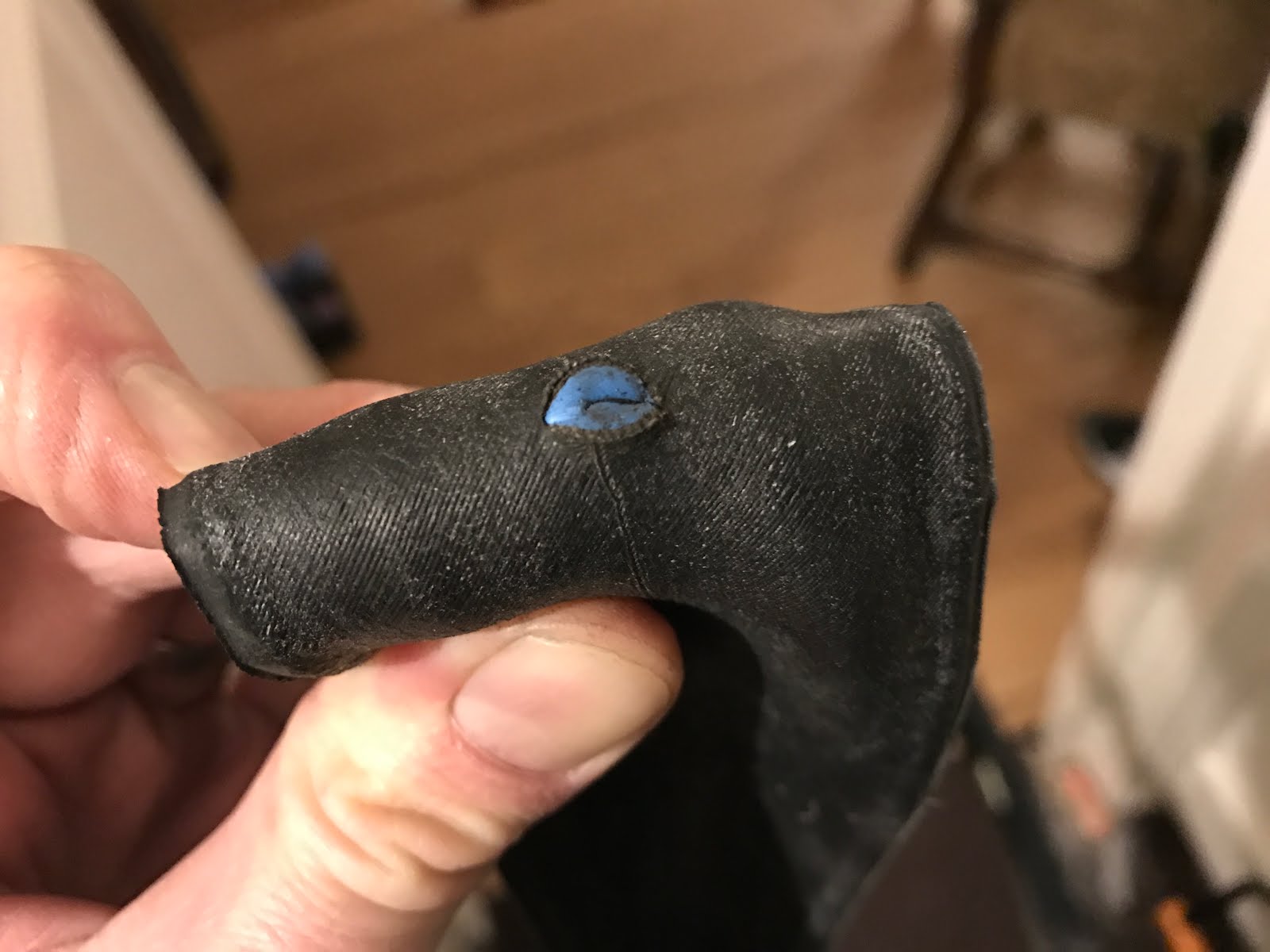
Having said that, I note two things: first, that I never checked the carcass for glass once in 18 months of hard urban riding, meaning that it was immensely scarred and had dozens of embedded shards - all without impairment. Secondly, that when I did puncture, the tyre was sufficiently stiff that I happily rode another 5kms at 20psi, with no damage to the rim. It seems to mimic automotive run-flats. Despite all that it is a folder and it has terrific pliancy, grip and feel given its strength. When you then ride something lighter and more wonderful, such as a Continental Grand Prix Four Seasons, you know what you've been missing. You're off into beautiful land. Yet for all that I'd give the Pluses a completely full, 100% score, for what they are. They have the strength of a far less nice tyre, yet remain on the radar of really nice tyres. I hope that makes sense. It's as though Schwalbe have achieved the impossible here. Shame about the puncture, but hey, it's London. This was probably the millionth piece of glass they encountered. I've now replaced both tyres -having reached advanced late-life- and begun my third set on a life of non-stop abrasion.

Innocuous on the outside
But not so innocuous on the inside

My 10,000km Year

Cycling 10,000 kms in One Year

The idea came from a much observed conversation with other cyclists at big-ticket events like the Etape du Tour in France: 'How much do you ride?' 'Ten thousand kilometres a year.' 

I have kept mileage charts for a decade, and I ride a lot, every day, and the closest I had come was just over nine thousand. So I thought: let's actually do this and see how it feels.

Bizarrely, the year in question was 2015, yet this is my first published thought on the subject in February 2017. Why?

There are hundreds of possible answers, but the chief one is that this completely arbitrary, self-imposed challenge became momentous. It attained a huge significance for me. To anyone looking in, it is meaningless. That in itself is a mystery.

The second rather prosaic answer is that I set out to write a book about it, yet the notes dried up as the riding took over. When the goal was reached I plunged into a semi-panic about the 'book'. Looking back, I chuckle. By making the riding 'work' I released a lot of tension that would have arisen from seeing it only as a distraction from work.

And here's the thing. The absolutely crazy lesson of the past decade is that I observe a strong correlation between time spent cycling and extra payments made on the mortgage. My big year in the saddle confirmed this. They say, 'time is money'. So hours and hours and hours spent pedalling around ought to register as non-productive leisure, if not luxury and even vice, if we're going to get Victorian about it. But cycling produces clarity of mind, efficiency in other areas of life, and perhaps above all focus. The mental health benefits are simply enormous, and perhaps largely underestimated. This registers as economic productivity too.

Anyway, trying to summarise it all, I am repeatedly drawn back to the energy room at the Science Museum in Exhibition Road, London. There, you find this immensely heavy fruit machine-like rotating wheel, and a screen that pops questions out including this one:


The correct answer is, of course, this one:


Except that it's not, is it? Why not cycle it? Apart from the fact that most UK trains are grossly polluting heavy diesels, and that their environmental credentials rest entirely on load factors, the brilliant reality of my big year in the saddle is that I rode Manchester to London, ('M2L') raised money for an autism charity, and smashed all my previous limits in what now seems like a completely epic day, the sort of day you remember forever. The fact that this achievement gloriously subverts the conventional answer to the transport conundrum raised by the Science Museum is fantastic. I'd go so far as to say it's counter-cultural. It is a brilliantly awkward truth that illuminates untrodden paths and invites us all to follow.

Having survived it once, I've signed up to do it again in 2017. As part of another 10,000kms.

Dec 31st, 2015. 10,000kms reached at this spot, 400 metres shy of George Bernard Shaw's
home in Ayot Saint Lawrence, at 12.05pm. Aside from his great fame as a playwright,
Shaw was a brilliant pioneer of cycling.

Sunday, 11 September 2016

The Bidlake Memorial TT Sept 18, 2016

There's still time to enter the Bidlake Memorial TT, to be held at Charlbury (Oxfordshire) from 10am on September 18 (more details below).

I rode the course yesterday with event founder, writer and cycling historian and historian Peter Whitfield. It's a simply beautiful Cotswold course with long, undulating stretches of country road, some drags and a climb out of Shipton, a couple of exciting descents where you can recover a bit, and an 18 mile long course that you do twice for 36 miles total.

Peter Whitfield, Charlbury, September 09, 2016
We rode it on 48x18 fixed wheel bikes, but very much as a recce. You'd want a geared bike but once again it's one of those sporting courses where the advantages of a TT rig over a road bike are marginal rather than obvious, particularly in light of the sections of climbing or descending, where handling comes into the equation.

Here are full details taken from the Oxonian CC website:

Bidlake Memorial Time-Trial

18 September 2016 - 10am
Bidlake Memorial Time-Trial takes place on the H36/18 based on Charlbury. This is the same course on which we run our April hilly, an attractive and challenging ride, entry must be made before 6th September.
The full course is two laps, 36 miles, but a one-lap version of 18 miles is also available. It’s a 10 am start and the HQ is the Charlbury Cricket Club. Full details on the CTT calendar ( https://www.cyclingtimetrials.org.uk/race-details/12657 ), with on-line entry, plus old-fashioned entries and any further info from Peter Whitfield: peterwychwood@hotmail. co.uk, call: 01608 810837.

Richard Lofthouse

Richard Lofthouse