Blog

Monday, 27 March 2017

COMMENT: Air Quality in London: Diesel at a tipping point: Fuel cell spotted

Sited, 12 March. Regent's Park Inner Circle.
1 of 26 Toyota Mirai fuel cell cars registered in the UK
COMMENT: Air Quality in London

2017 will hopefully be looked back on as a tipping point for air quality in London and perhaps even the UK. January saw some dreadful pollution and as a cyclist I noted extensive irritation to my nasal tract and throat. I kept producing phlegm. Since then I have experimented with masks but we all know they're not very nice to wear and are not a 'solution' to the underlying problem (do we want all Londoners and their children clamped to masks all day?).

Wearing my motoring journalist hat, the good news is that the Geneva Motorshow this year was heavily dominated by electric propulsion and the 'D' word has become a dirty word post-VW, Renault and Nissan scandals (among others). See my extensive report on the diesel tipping point

http://www.carandvanfunding.co.uk/theres-no-d-in-geneva/

The prettiest vehicle at Geneva was a Bentley - and it was electric
The good news is that the SMMT, the UK car maker trade body, has just revealed that February saw UK diesel sales dropping off a cliff. They fell 9.2% year-on-year. That's fantastic and appears to confirm a trend that is much stronger than it might have been, and much more sudden. People are not stupid. They bought diesel vehicles in good faith and I was the owner of one 2009-13. They produced marginally less CO2 so were sold as 'green'. The trouble is that over time their more immediate emissions, especially nitrogen oxide and other particulates, become filthy, and that's before we even embark on the car maker emission scandals - enter VW and more recently the Renault-Nissan Alliance. Now the cat's out of the bag, no one wants a diesel, and their residual values are about to plunge (if I'm not mistaken).

Now that half the fleet in Europe and UK is diesel, the full horror of the pollution is plain, with an estimated 9,400 Londoners a year dying prematurely from the pollution. It's completely changed my perspective as a cyclist - although long before the VW scandal erupted in September 2015, I was well aware of the black soot coming out of all manner of vehicles, even newly registered ones. The really horrible fate is being stuck behind a pre-Diesel Particulate Filter (DPF - mandatory since 2007 but often not working correctly because blocked) white van, Vauxhall/Renault/VW-Group brand/Ford, or indeed most luxury bruisers, old E-Classes, Five Series Bimmers, many with really big diesel engines that start to compare in emissions with the ultimate culprits, the buses and black cabs.

Anyway, back to a consumer perspective. You'd be surely crazy to buy a new diesel from here on, owing to the fact that the government, twice sued by Client Earth and twice lost, is shortly (April we believe) to reveal a raft of hopefully credible measures to clean things up. If there is a comprehensive diesel scrappage scheme then you might prosper if you have an older diesel, but who knows. The devil will be in the detail.

The other excitement is that the government just added £23 million towards hydrogen infrastructure. See the above image of the Toyota Mirai I spotted the other week. I'd been lucky enough to already drive this vehicle in May 2016 at an industry event. It's a large, nearly-silent, plush limo; very comfy. Terrific. But this is the first one I've seen 'On-The-Road'. The driver said it was great because with a handful of service stations already supplying hydrogen to all four corners of London, (even Cobham, on the M25) he said his range was the same as a diesel but a fill-up took no longer than a petrol one. A lot of senior industry people think the hydrogen fuel cell will leapfrog over hybrids and electric vehicles because they are more efficient, producing electricity on demand without any transmission losses, they don't require loads of heavy batteries or ugly charging points, and their sole emission is water. Of course, there's a lot of work to be done on producing green hydrogen in the first place, but that will come.

Final thought: the Chinese-backed Coventry factory that opened this week for manufacturing the zero-emissions capable black cab is great, but I still don't know why black cabs are exempted from prospective 2019 Ultra Low Emissions Zone, nor why according to Steve McNamara, the cabbie's trade body boss, it'll need six-seven years to convert the fleet. This is incomprehensible, as is the fact that there is no mandatory retirement age for cabs. There are 23,000 thousand of them in London, half of one percent of the fleet, but they cause an estimated 20% of the emissions due to being extremely dirty and because they drive around all day. They also idle endlessly at ranks even when not moving, which is flabbergastingly bad: a total fail. If there is one way to quickly clean up London's air, you would start by scrapping all diesel cabs, plus all older buses as funding permits.

On a cheerier note, and going back to the future, there was one sensational fact about the Geneva show which went largely unremarked: Hyundai are coming, big time, and they are years ahead of the Euro-car makers for fuel cell technology, as are Toyota. Even Brexit folks are going to go out and buy these vehicles when they look as pretty as this and are not consigned to 'odd-ball' status:

Prettier than a Jag iPace.
And it is a fuel cell vehicle with a huge range.
And it's going to be reality sooner than we think. 


Friday, 3 February 2017

Redux: Schwalbe Durano Plus puncture!

REVISITING THE REVIEW: Schwalbe Durano Plus tyre, 700x23c Road, folding

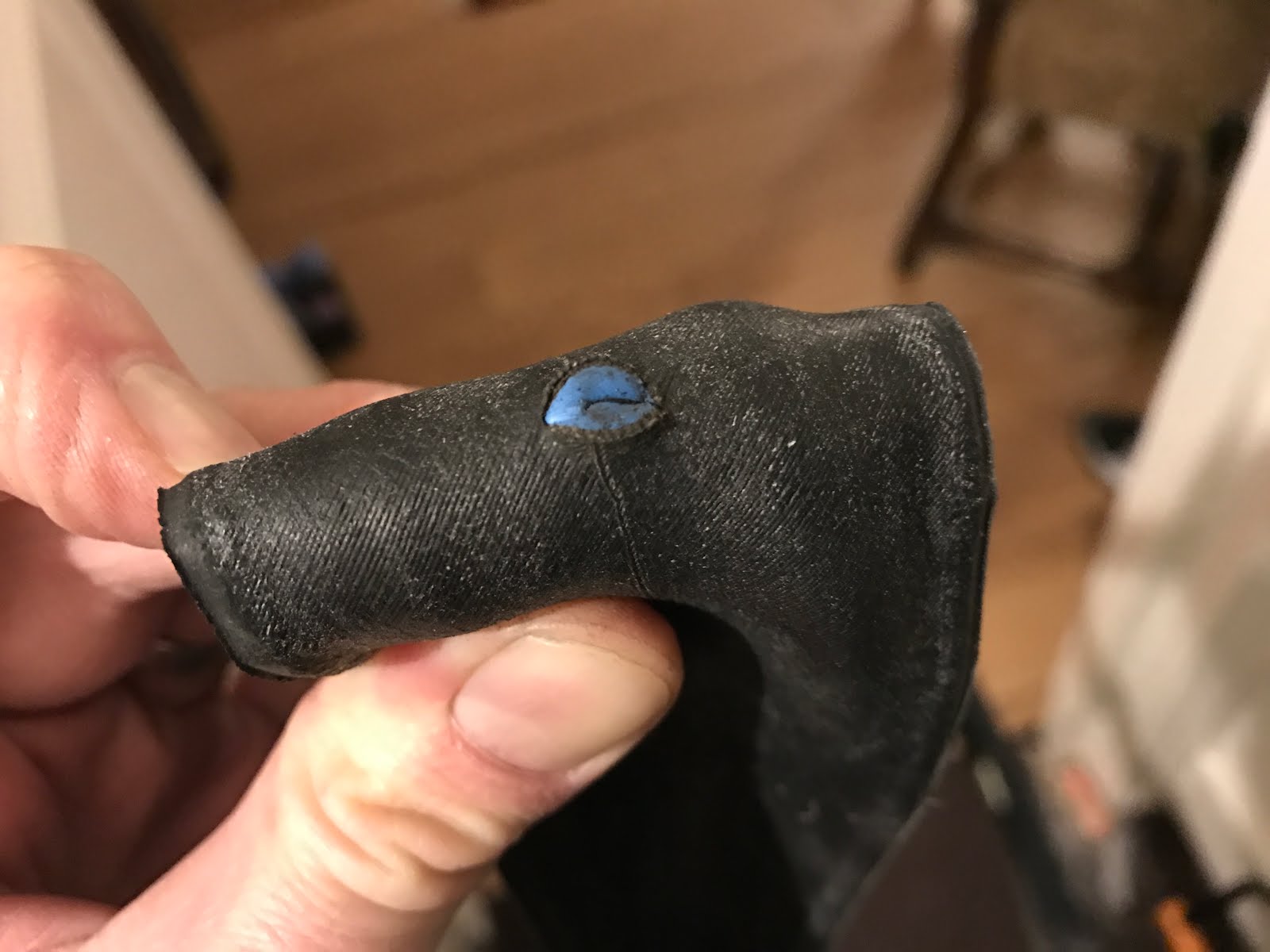
Further to my previous review about this tyre. The impossible has happened. I got a puncture 7,000kms into the set of tyres that replaced the set I previously reviewed.

Having said that, I note two things: first, that I never checked the carcass for glass once in 18 months of hard urban riding, meaning that it was immensely scarred and had dozens of embedded shards - all without impairment. Secondly, that when I did puncture, the tyre was sufficiently stiff that I happily rode another 5kms at 20psi, with no damage to the rim. It seems to mimic automotive run-flats. Despite all that it is a folder and it has terrific pliancy, grip and feel given its strength. When you then ride something lighter and more wonderful, such as a Continental Grand Prix Four Seasons, you know what you've been missing. You're off into beautiful land. Yet for all that I'd give the Pluses a completely full, 100% score, for what they are. They have the strength of a far less nice tyre, yet remain on the radar of really nice tyres. I hope that makes sense. It's as though Schwalbe have achieved the impossible here. Shame about the puncture, but hey, it's London. This was probably the millionth piece of glass they encountered. I've now replaced both tyres -having reached advanced late-life- and begun my third set on a life of non-stop abrasion.

Innocuous on the outside
But not so innocuous on the inside

My 10,000km Year

Cycling 10,000 kms in One Year

The idea came from a much observed conversation with other cyclists at big-ticket events like the Etape du Tour in France: 'How much do you ride?' 'Ten thousand kilometres a year.' 

I have kept mileage charts for a decade, and I ride a lot, every day, and the closest I had come was just over nine thousand. So I thought: let's actually do this and see how it feels.

Bizarrely, the year in question was 2015, yet this is my first published thought on the subject in February 2017. Why?

There are hundreds of possible answers, but the chief one is that this completely arbitrary, self-imposed challenge became momentous. It attained a huge significance for me. To anyone looking in, it is meaningless. That in itself is a mystery.

The second rather prosaic answer is that I set out to write a book about it, yet the notes dried up as the riding took over. When the goal was reached I plunged into a semi-panic about the 'book'. Looking back, I chuckle. By making the riding 'work' I released a lot of tension that would have arisen from seeing it only as a distraction from work.

And here's the thing. The absolutely crazy lesson of the past decade is that I observe a strong correlation between time spent cycling and extra payments made on the mortgage. My big year in the saddle confirmed this. They say, 'time is money'. So hours and hours and hours spent pedalling around ought to register as non-productive leisure, if not luxury and even vice, if we're going to get Victorian about it. But cycling produces clarity of mind, efficiency in other areas of life, and perhaps above all focus. The mental health benefits are simply enormous, and perhaps largely underestimated. This registers as economic productivity too.

Anyway, trying to summarise it all, I am repeatedly drawn back to the energy room at the Science Museum in Exhibition Road, London. There, you find this immensely heavy fruit machine-like rotating wheel, and a screen that pops questions out including this one:


The correct answer is, of course, this one:


Except that it's not, is it? Why not cycle it? Apart from the fact that most UK trains are grossly polluting heavy diesels, and that their environmental credentials rest entirely on load factors, the brilliant reality of my big year in the saddle is that I rode Manchester to London, ('M2L') raised money for an autism charity, and smashed all my previous limits in what now seems like a completely epic day, the sort of day you remember forever. The fact that this achievement gloriously subverts the conventional answer to the transport conundrum raised by the Science Museum is fantastic. I'd go so far as to say it's counter-cultural. It is a brilliantly awkward truth that illuminates untrodden paths and invites us all to follow.

Having survived it once, I've signed up to do it again in 2017. As part of another 10,000kms.

Dec 31st, 2015. 10,000kms reached at this spot, 400 metres shy of George Bernard Shaw's
home in Ayot Saint Lawrence, at 12.05pm. Aside from his great fame as a playwright,
Shaw was a brilliant pioneer of cycling.

Sunday, 11 September 2016

The Bidlake Memorial TT Sept 18, 2016

There's still time to enter the Bidlake Memorial TT, to be held at Charlbury (Oxfordshire) from 10am on September 18 (more details below).

I rode the course yesterday with event founder, writer and cycling historian and historian Peter Whitfield. It's a simply beautiful Cotswold course with long, undulating stretches of country road, some drags and a climb out of Shipton, a couple of exciting descents where you can recover a bit, and an 18 mile long course that you do twice for 36 miles total.

Peter Whitfield, Charlbury, September 09, 2016
We rode it on 48x18 fixed wheel bikes, but very much as a recce. You'd want a geared bike but once again it's one of those sporting courses where the advantages of a TT rig over a road bike are marginal rather than obvious, particularly in light of the sections of climbing or descending, where handling comes into the equation.

Here are full details taken from the Oxonian CC website:

Bidlake Memorial Time-Trial

18 September 2016 - 10am
Bidlake Memorial Time-Trial takes place on the H36/18 based on Charlbury. This is the same course on which we run our April hilly, an attractive and challenging ride, entry must be made before 6th September.
The full course is two laps, 36 miles, but a one-lap version of 18 miles is also available. It’s a 10 am start and the HQ is the Charlbury Cricket Club. Full details on the CTT calendar ( https://www.cyclingtimetrials.org.uk/race-details/12657 ), with on-line entry, plus old-fashioned entries and any further info from Peter Whitfield: peterwychwood@hotmail. co.uk, call: 01608 810837.

Tuesday, 17 November 2015

The World According to Lofthouse

CLEAN AIR is in very short supply in London and many other cities. The cycling lobby have met a fork in the road. If they campaign they make cycling sound like a health hazard. If they don't campaign, they ignore one of the biggest problems of our time. Drayson Technologies have launched a laudable clean air crowdsourcing widget and movement called CleanSpace. I've subscribed for three, one for my wife, one for me, and one for a charity. This could become global. It's very clever. SEE: https://our.clean.space/

THE VW SCANDAL is ironically a good thing. Diesel was already in trouble, but now it's truly besieged. We'll now see a raft of hybrids, plug-in hybrids, and eventually charging points. The hero vehicles in London are currently: BMW i3 and Mitsubishi Outlander PHEV. The beemer is radical, way-out-there chic. The Mitsu shows that if the world wants SUVs you gotta make PHEV versions of SUVs, not micro-cars wearing holier-than-thou dog collars.

DISC BRAKES serve commercial interests alone, unless you ride heavier bikes/ haul a trailer/ e-assist/ cargo bikes, where they obviously serve a purpose. Pro-Peleton? They have no choice if they want to be sponsored. But the brutal truth is that disc brakes:
  • add weight
  • add complexity
  • detract from clean lines
  • make wheel changes slow
  • expose the rider to even more forms of potential crash damage, from rotor slicing
  • add cost (and therefore OEM profits)
ON THE SUBJECT OF COST road bikes suddenly went through the roof about two years ago, almost as if the industry flicked a switch. When I bought my 'then top of the range' Canyon Ultimate CF SLX Dura-Ace in 2010 it cost £2,800. Equivalent bikes from fully branded makes that use retailers are now £5k ++. Your best bet is to buy the right frame and then source the carbon wheels carefully and within a budget. Voila: you can get the five grand bike for 2-3k. 

BASE LAYERS have cost me a lot of trial and error money. While I initially fell for Rapha merino they are very expensive. Depending on the wool vintage, not all of them have been scratch-free, in particular the thinner vest ones that you can wear for commuting under a smart shirt. I've found a much better alternative: M&S T-shirt by David Gandy for the Autograph range. It's half cotton and half synthetic, parading under the label 'modal' ("like silk" the shop hand waxed - acrylic I presume). Go a size smaller and you get a terrific drape: a real base layer. I've trialled it extensive in commuting and road riding. They cost £15 each. That's my wardrobe tip for this winter...

LIGHTS TRUMP HI-VIZ but evidently loads of folks don't see it that way. I just keep seeing peeps in hi-viz and fluo, thinking it gets them out of needing lights. You can dress all black and be fine as long as you have A1 lights, preferably two front and two back to allow for malfunction and fading batteries. Isn't this obvious by now?

SECURITY SKEWERS CAN BE AMAZING. The Atomic 22 'complete suite' that I've invested in over two years for my Enigma Ethos 'do it all town bike and audax' is certainly one of the loveliest revelations I've ever had in cycling: my only regret is not buying ALL of it at the start. I mean saddle, seat post, stem bolts - all of it. What happened instead was that I baulked at the price, got wheels and seat post only (to replace Pitlock which are so-so) - and lo and behold, on a bright summery day someone stole my handlebars, the shifters and the saddle. £300 to replace that lot. Another £200 on the additional security bolts. But that was the revelation. Far from being ugly or utilitarian, those items are simply BEAUTIFULLY MADE and BEAUTIFULLY PRESENTED and have IMPROVED the bike. The wheel skewers for example are considerably lighter than a quick release, yet made of stainless steel. ATOMIC 22 are the Chris King of England - salute Patrick Wells, the founder. What I don't understand is why this stuff is not being fitted as original equipment. Cost? Yes, but we've reached the point where in London at least, you can't lock a bike without component theft on an industrial scale. The other benefit is that I only need to carry one mini-U-lock not three.

REVIEW: End of front light test, Exposure Strada Mk VI (2016 model)

REVIEW: End of front light test, Exposure Strada Mk VI (2016 model)
Digital reading ends range anxiety

Burn programmes: set up and forget


This is the best light that I have ever encountered for road use. I will admit to being partial to Exposure Lights - they're hand made at a UK base down in Sussex, which is in itself a terrific achievement in an age of plastic junk.

But until now I've bounced between two extremes: a JoyStick at one end, which I never really understood was meant to be a helmet light...and a Six Pack which offers so much light that if you mount it fractionally wrongly you'll be in big trouble on the road, blinding Minicab drivers into instant rage.

But we've moved beyond 'bigger and brighter is simply better' to a more discriminating solution of real problems. I don't downhill in the dark. I commute in London and sometimes in more rural settings, where I want to see potholes before I feel them. Even the outer perimeter of Regent's Park has some very dark spots.

I liked...

  • Digital read out eliminates range anxiety. 35 hours on LOW and a full charge - outstanding. 
  • No 'flash back' into rider's face. Instead it casts a puddle of light down and out, exactly what you want. 
  • Overall size and weight. Perfect 'middle' solution lies between heavier and lighter solutions.
  • Fits in any jacket pocket.
  • Mounting bracket is very secure and fast to fit.
  • Comes with remote switching so you can flick through settings without shifting hands position. 
  • 'Puddle' light AND 'spot light' cover all bases in a road setting
I didn't like...
  • The little rubber grommet that plugs the recharge port is fiddly and bounces free so it hangs loose. This is the one thing that lets the light down a bit, although it's only an incidental detail.
  • Not sure I need the remote switching - the pressure back panel is so good it does the job on its own.
  • Could use more guidance on mounting angles. You still need a slight 'down' angle to avoid blinding drivers.
CONCLUSION

Beautifully machined alloy body reeks of quality. Battery life and overall lumens output have gone sharply up even compared to three years ago. If you have an old light (as long as it is an Exposure) Exposure have an exchange programme so don't hold back upgrading. I was skeptical but the improvements over just two years have been remarkable.


Exposure have learned to 'curate' light

Sunday, 27 September 2015

REVIEW: Exposure Lights Strada Mk 6 (2016)


Bathed in red: Startline, 2015 Rapha Manchester2London
We're an Exposure household, you might say -

Exact burn time left. No more 'range anxiety'

Exposure Lights Strada Mk 6 (2016)

Lighting. Come late August, a night out in London and oops...no lights and a self-conscious flit home, 'hypocrite' branded across my conscience. I'm not too sympathetic for riders who don't bother with lighting.

This year was a bit different. September 6th was the Manchester2London ride, put on by Rapha to raise money for Ambitious about Autism. So I had an early foretaste of the winter riding that lies ahead. It was a gorgeous day of sun and light wind. But it began and ended in the dark as all epic adventures should.

I noticed a lot of miniscule lights around the field of 200+ riders, saving weight and bulk, but also some impressive stuff. One abiding memory was racing the last leg from Hertford to the Olympic Velodrome in East London. There was a point when we put our lights on, but then another point when nightfall became a reality. We hurtled into a black wood, but the guy in front of me had an Exposure Sixpack, surely one of the ultimate lights money can buy, with a 'Wembley effect' 2,000 lumens. I just followed him. I could see every pot hole and it wasn't even my light.

My choice of weaponry was an Exposure Flash on the front, and a Flare on the back tucked in beautifully under the saddle rails using Exposure's saddle rail bracket (£7.95). The Flash functioned only intermittently despite me deploying a fresh, spare battery I'd carried since Manchester! So I have now bought a Mk 6, 2016 model Strada, a big step up and a chance to conduct a test over the next couple of months.

I'm planning to include some night riding, the usual epic amount of London commuting and some Audax. So far the Strada looks like a huge advance, with precise burn times relieving much anxiety. But the niggly question I've got is whether it is better or worse than a Sixpack. I've got a Sixpack. The argument for it is that it's a nuclear weapon that brooks no argument. The argument against is that it's comparatively bulky, too heavy for club riding, and so bright that in practice you run it on low beam 99% of the time. If you mount it at the wrong angle you blind drivers to the point where you attract nothing but pure aggression. So arguably it's overkill...except that I love it, especially when conditions are terrible and you want to be lit up as much as possible, or in the countryside when actually, yes, you have to light up that lane and read the potholes.
2016 Strada has two beams: puddle and spot
Programs allow tailor made burn timesREVIEW: 

Richard Lofthouse

Richard Lofthouse