Blog

Sunday, 16 June 2013

Cycling Mont Ventoux, top five dos and don'ts

View from Gorges. Provence is great cycling country
Mont Ventoux, top five dos and don'ts. JUNE 2013

1. Don't leave behind the knee warmers
This wasn't my first ascent of the 'Giant of Provence,' summit 1,912 metres (6,273 feet). I did it in the 2009 Etape du Tour, beginning at Bedoin after 155kms, in blazing heat and no wind. By comparison, this time I arrived in Bedoin to be greeted by the usual mistral winds, gusting violently to over 100kms at the top, and battering all the foreslopes in ways that were unusual by local standards, at least for June. This and the unseasonal snow that had re-opened one of Provence's ski resorts just the previous weekend. The snow had gone except at the summit, but it remained cool. Pulling in at one of the Bedoin bike shops to buy knee warmers, I was advised that it was only safe to go up if I was willing to walk the last 7kms from Chalet Reynard. So we waited two days and then climbed it early on a Sunday morning, in bright sun shine. Steph clocked 1 hr 47 and I came in around ten minutes faster (but from St Columbe, the next village up, so add +/- 20 minutes from Bedoin). The winds at the top were still fierce and the temperature cool. So that's the first piece of advice: carry a 'light winter clothing' system which extends to a jacket (preferably waterproof and wind proof), full finger gloves and knee and arm warmers. A lot of riders find they have to do a wardrobe adjustment halfway up. Temperatures can be 10 degrees different at the base and peak.

2. Keep your bike in the hotel room even if told not to
I'm based in Hackney, East London. We think of Provence as a much more secure sort of place, where you might happily leave bikes in locked cars and that sort of thing. We came close to being robbed. It might be an isolated incident or it might represent a crime wave that no one is owning up to, but what happened to our neighbours at Hotel La Garance should be taken as a warning. Here's what happened. Le Mistral was blowing. There were lots of battering and blowing noises. Just after midnight, right outside our ground floor room, an experienced thief neatly punctured a hole beneath the lock of a Belgian registered Mercedes Sprinter Van, gained entry and took the first bike of several, a three thousand euro Wilier, not six months old. He was obviously on his own. He rode away on it and left the rest. Nobody heard a thing including us, and despite the pea gravel. The bike was not insured (of course it wasn't, have you tried to get an insurance company to cover a bike unsecured inside a van? They won't - this is why). The hotel we recommend - it's run by a real hotelier, Dutchwoman Johanna Beaumont, and it's situated right on the Bedoin climb, so you ride right off the doorstep and not get lost. But she still puts up signs saying 'No bikes in rooms'. We were very lucky the thieves didn't get to my LOOK or Steph's Specialized, locked in the back of our rental car. Very lucky. The bikes came inside the next night.

3. Pace yourself
If you are only doing the Ventoux you can treat it like a 50 mile time trial - it's two hours at that sort of effort to clock what is considered to be a very respectable club rider time. The record was set by Iban Mayo in the 2004 Dauphiné Libéré. He did it in 55′ 51″.

4. It's not the Etape
By which I mean the roads aren't closed. It's laughably man-land and all the tribes are out: bikers, drivers, cyclists. There was a club of Renault 5 Turbo nuts (visible in the distance of the photo below); there were a lot of bikers coming down as I was going up, at high speeds, and sometimes coming right over onto my side of the road. That's OK but it doesn't allow for wobbling around. So get your gearing sorted. You'd think people would realise this but they don't. You need a 34 tooth inner chainring, a compact. Either that or you're going to be a top rider smashing it on a 39x25.

5. Don't forget the descent.
The classic ascent is from Bedoin. That allows you to descend to Malucene or back down to Chalet Reynard and on to Sault. The Malucene descent is the most fun because it goes on and on, the surfaces are excellent, and the sight lines are the best. The Sault road is bumpier, while going straight back to Bedoin is fine (I did this), but you really have to be careful because of the steep gradient. It's definitely the moment that you begin to respect the Pros and to start thinking about where precisely your limits lie in bike handling. Don't forget a gilet. You'll need it even if the weather is fine.
Mont Ventoux, June 2, 2013. Alps visible on horizon. 

Sunday, 12 May 2013

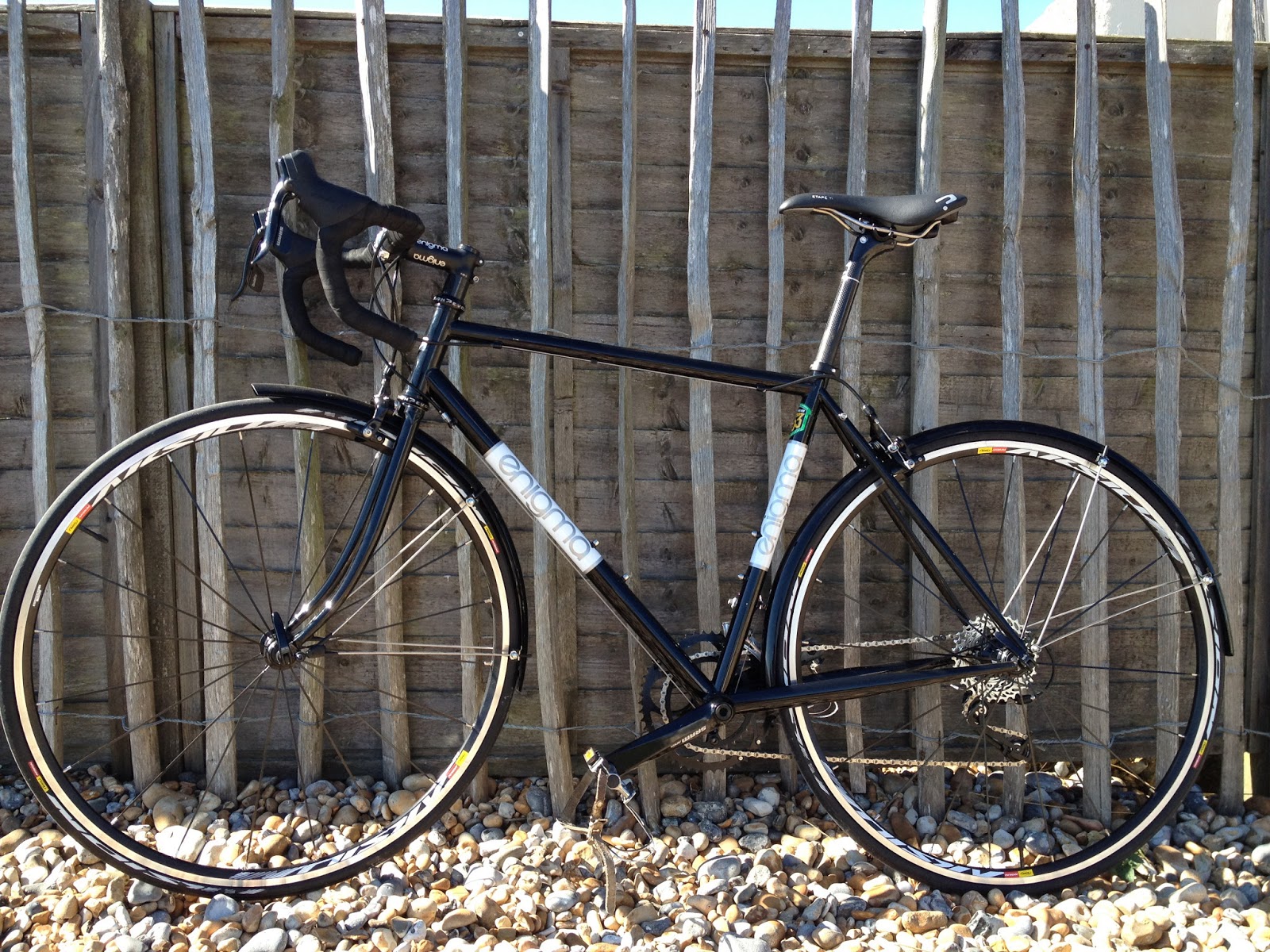
REVIEW: Enigma Ethos Steel, Custom Build
£3,000

Visting Enigma, swimming in the sea afterwards
I know this is a big roaring debate currently, whether you should spend any money on your commuter/hacker/winter trainer. But for me, it was an easy decision because I've clocked up c.20,000kms in three years on my trusty Focus Mares, mostly commuting, and spent far more hours on this, my humblest ride, than on all the others put together (the cross bike, the TT bike, the road racer, the fixie and the trainer........).

I decided I wanted a Rohloff hub gear build from Enigma, the titanium and steel specialists down in Sussex, Southern England, but in the end I opted for an Ethos-based custom build, much lighter at the rear end with a derailleur.

Jaco Ehlers did a great job measuring me up
How it unfolded

First Enigma. Jim Walker sold his distribution company and founded Enigma a few years ago, buying the then-bankrupt Omega. Today he's doing 700 bikes a year and targets 2,000 as a comfortable but still highly bespoke business.

Graeme Raeburn, Rapha's chief designer and a friend, had a Reynolds-based steel racer and spoke highly of it. I decided to investigate further. Enigma is an impressive company leading the charge back to British, hand-made bikes. I decided I'd pay a visit.

Ti or Steel?
I decided for steel over titanium

The Test Bike - I almost wanted this one, right away
I visited Enigma in September 2012, with a maximum Bike-to-Work voucher of £3,000 in my back pocket. I rode a ti bike and then a steel one made of Reynolds 853. Steel won the day. The titanium was a racier bike but I wanted one for city life and audaxing would be its fastest outing. I found the titanium to be tighter and less comfy than I had anticipated. Steel frames, mated to the right tyres, roll beautifully. There's a nobility about the progress and bump absorption. With panniers on the back on a daily basis, weight wasn't my number one concern, but I wanted to match my 25lb, alumnium-framed Focus Mares Cross/commute bike.

Getting the fit and build right
Jaco Ehlers, a South African, sorted me out brilliantly and was very generous with his time. Lots of fitting led to a quite different-from-stock build, with a taller head tube for city work, but on a tight, road-bike derived geometry. I ditched the Rohloff idea as soon as Jim showed me one. It weighes a tonne and costs even more. The build was coming out at a fantastic sum of money. I got nervous. In truth, I'd only had my derailleur bent once in three years of London life. It's not that difficult to fix and you can easily replace it.
I opted for classic script, instead of 'modern'

Enigma moved to a larger facility early in 2013
The money goes into the custom frame. We decided on Reynolds 853, which is more comfortable than 931 or 953, which are both very stiff and for racing. Enigma's renowned frame builder Mark Reilly was on hand and he told me that 853 was the best tubing for stiff/compliant, given the intended use. I wanted a steel fork with bosses for a low rider, to accommodate light touring. With all the boxes ticked, the rest of the build was Shimano 105 with tweaks, and a cheap but strong set of stock, Mavic Aksium wheels. Smart in black, and my favourite fast commute hoops, very cheap to replace and just 1,700 grams the pair. I got a smaller large chain ring, an FSA 46 toother instead of the 50/34 compact. In my view the 16 tooth drop of the compact is far too much, and for commuting, the 50 is simply too high. In the city, it means you barely ever go on the big ring and effectively waste half the transmission, accelerating the wear on the inner ring. These are the sort of details I wanted addressed. Another consideration was avoiding toe overlap with the front mudguard, even with size 44 shoes, clips and straps. This was achieved by extending the front fork out by 40mm, and has solved one of the big bugbears of the Focus. To keep a lid on weight I ordered a Tubus Logo Titan titanium rack, and checked the box for a carbon seat post. For a touch of bling, I ordered the Chris King headset.For a touch of real world, I ordered Cane Creek cross-top brake levers, which I swear by on a
5
My Bike: battleship grey and black
commute. They give you hair-trigger braking.

Colour dilemmas
It's one of the great things about a six-month wait for a custom project. You can still change your mind. I'd specced Ferrari Red but had a sudden change of heart. Battleship grey - one of the sexy, avant-greys that are circulating right now on certain Bentleys and Porsche 911s, retro but modern - had come into view and was subtle, less likely to attract thieves but gorgeous to my view, especially with the matched, painted handlebar stem. I called up Jaco and I was lucky: they were due to get the bike painted a week later.

Picking it up
One of the oddities was seeing the bike for the first time at Bespoked, Bristol, where Enigma had asked me if they could feature it on their stand. I was very happy with what I saw, but I couldn't ride it or take it away. A week later I drove down to Sussex and Enigma's new facility at Hailsham. There were a few last minute adjustments and off I went.

Riding it
I've laid down 300kms in little over a week, which included an audax, and a tonne of commuting. The bike is leggier and livelier than the relaxed Cross-bike geometry of the Focus. It is faster but I feel less inclined to cowboy about, partly because of the Schwalbe Double Defense 700x25 tyres (versus Schwalbe 700x28s on the Focus, which were necessary to soften the harsher alloy frame). There is no toe overlap. The titanium rack is exceptionally stiff. I use the whole transmission and switching between chain rings no longer leaves me grabbing a handful of compensating sprockets at the back. I'm happy to return to road brake calipers instead of MTB V-Brakes. They are slightly softer, but the V-Brakes required constant adjustment. That sucked. I love the looks and the grey/black combo is a success. My neighbour is a graphic designer and he is envious to a silly degree.

Final Thoughts
I was treated exceptionally well by Enigma and recommend them to anyone, unreservedly. There is one obvious comment applying to custom builds. It helps to know what you want but to be flexible as well, and better to be fairly involved than passive, otherwise what's the point? Above all, you have to be reasonably patient. You know if you are or aren't. If you get the colour 'wrong', you can take the bike back when it's all scratched up and get it done all over again. That's the magic of a proper, old-school build in the country where you live. You can even meet the guy who made your frame, in my case Joe Walker, Jim's son. It took him three days of painstaking labour. I am not against factories in Taiwan. Not at all. But I am firmly in favour of doing things properly, and provenance, as in the food chain, is just as deisrable when it comes to the most important object in one's life: one's bicycle.

Final, Final thoughts
After a fortnight of hard use, my only upgrades so far: black alloy dust caps on each inner tube valve, from Brick Lane Bikes (£2.00); Brooks Swallow saddle (£129.99). The saddle is my 4th Brooks (the rest sold off quickly) and so far it is the only one that is comfortable from the off - I had investigated buying a well worn-in B17 from eBay, but objected to the prices, while the 'worn-in already' range that Brooks sell is only available in tan! The Swallow is a racing cut but a very supple piece of leather with plenty of give. We'll see in six months whether it really is here to stay or yet another disastrous episode of Lofthouse-weakness-for-beautiful-object followed by a loss-making eBay expedition.
The only fly in the ointment with the Enigma, is that the Pitlock seat collar bolt doesn't fit the supplied seat collar clamp, so I am terrified that someone is going to allen-key their way to £200-worth of carbon seatpost and Brooks. This makes me think that bespoke bike builders should be making a much bigger effort (this includes Enigma!) to integrate a full suite of these security products into the original spec, if desired by the owner. There is nothing more annoying than taking delivery, only to have to replace every bolt and skewer with after market additions, and then finding, surprise surprise, that some of the parts don't translate over. That's the bike industry for you. It can be a very annoying place. Salvation might be at hand. I am talking to a simply brilliant new company called Atomic 22 (www.atomic22.com). The fantastic couple behind it, Patrick Wells and Ayantika Mitra have a fully fledged suite of beautiful, light weight and very secure bolts and skewers for every possible bit of the bike from brakes to saddles. That might be the next upgrade - but if I do it, I'll do it big and work over the whole bike in one go, so that I end up with one universal 'key' rather than a mix of Pitlock / Atomic. I'll pay a visit to Atomic in the process and report back, probably in June.

Thursday, 9 May 2013

REVIEW: A2B Hybrid 24 e-bike, RRP £1,999
Retailers in the UK, www.wearea2b.com

It goes A2B. That's anti-climb glass atop the wall.

Rear hub motor, 250W

Integrated battery pack has excellent security

London cobbles, rite 'ard
It was my pleasure to recently interview Naveen Munjal. Bear with me. He's the managing director of HeroEco, the electric division of India's largest motorbike maker, Hero Motocorp. They make several million motorbikes and scooters a year. That's of direct relevance to this review, because the A2B Hybrid 24 is a hybrid in more ways than one.

In one obvious sense, any e-bike (or pedelec, to use the correct term) is a hybrid. It has a motor that works in concert with a pair of human legs, the same way a Toyota Prius mates a motor to a combustion engine. The holy grail of e-bike fanciers is an urban nirvana in which the simple beauty of the bicycle is magnified by an electric motor, making it faster and further but without any of the registration, licence, training and insurance and parking burdens that apply even to the lowliest Vespa.

But the A2B Hybrid 24 is also a hybrid of bicycle and scooter design, and clearly reveals the impact of serious engineers coming at a brief from a non-bicycle trade direction.

The unconventional Y-frame was inherited from Ultra Motor, the UK company that created the Hybrid 24 and was acquired by Hero a year ago. It's quite massive, with substantial internal routing for the cables, and prominent welds that are very neat but still prominent. What do I mean by that? I'm not holding back from using the word ugly. But it's not ugly; it's burly, or some other word.

And that's the point I'm trying to make here. This bike is very lightweight compared to a Vespa, but it's barely comparable to a bicycle, particularly if you're viewing it from Planet Racing Bike. In that sense the Hybrid 24 fills a hitherto non-existent sector. You cannot do it justice by only coming at it with pre-conditions and prejudices.

As I ride it away, I keep the motor shut off and spin a low gear. It knocks along OK, but compared to my normal ride (pictured at the bottom of this post, for context), it's terribly upright, even by Dutch bike standards, and massively wide at the handlebars. It's as if this is aimed at a global citizen for whom a bicycle is unfamiliar, or scary.

Stopping to get the juice on, I'm impressed by the way you just wave a fob across the little digital speedo/battery indicator. It lights up neon blue. And then whoosh, as soon as I push down on the crank, the whole 250W mnotor pours out all its torque and thrusts me forwards. More follows until I hit 16 mph (25KM/h), and when I tackle my nearest hill, it makes mincemeat of it. Later on the same day, I come home via my local cobbles in Murray Mews, a secret testing ground I use for bikes. The A2B is in its element on this bad surface. The big tyres and front suspension just shrug off the cobbles as the rear hub motor powers it forwards. 

But it's not all good. I'd deliberately timed my test of the A2B with a week of heavy turbo training at home. There are times when you want the commute to go away. I had fantasised about this bike whispering me along, like a two-wheeled Rolls Royce. But the control system that defines an e-bike is not a power-on-demand (throttle) system like an e-scooter. It's a hybrid. If you don't pedal you don't get assisted. The 35kg weight of the A2B robs the motor of much of its substantial power, and by the time I reached work I had a soaking wet back, exacerbated by the need to wear a rucksack - the battery pack precludes hanging a pannier.

When I got home, I had to carry the A2B up a flight of stairs and wrestle its width and girth into my front room. You could not do this on a daily basis. 35kgs is alot of weight. Getting it down stairs is like controlling a runaway express train.

The weight totally determines how the bike actually handles. It is a sledgehammer to crack a proverbial nut. It's a very difficult bike to love if you're coming over from bicycles. If you're pushing on from a junction and encounter a pot hole, the driving rear wheel can bounce out and slam down - I think we call that axle-tramp, and might explain why such heavy tyres were chosen for an unsuspended rear triangle. At the front end, the suspension is supple enough, but suffers from dive under braking, a reminder that the budget has gone on the Berlin-sourced design (hence the groovy black) and the electric components, while other parts are lower than would be found on a conventional bike in this price range.

The saddle, seat post, derailleur (Shimano Alivio - nothing much on a £2k bike) handlebar, bell, disc brakes, chain and pedals are all straight out of bargain bicycle supply chain. The electric display, frame design and finish, tyres (Kenda 24 x 2.35, inflatable to 40 psi, slick tread), 36-spoke wheels, battery and charger, control systems and motor are all taken from somewhere burlier than your typical bicycle, even at the MTB end of the spectrum. They all feel like overkill for a bike that tops out at 16mph and is easily overtaken by any club rider training around Regent's Park, as I discovered.
The alternative: black graphics on grey, instead of grey on black

So my verdict? There is another generation of speed pedelecs hitting non-EU markets (USA, Switzerland) with double the power. That would suit the Hybrid-24. I wanted more power more of the time. As it stands, it's an interesting experiment but it doesn't solve a problem, it just migrates it some place else.

In the EU, e-bikes are legally restricted to 250 Watt motors, and 25km/h top speed (you can go faster under your own stream, but you won't). So the only way ahead is to reduce weight. This is why Richard Thorpe spent a fortune at Go-Cycle to perfect a magnesium wheel for his e-bike, which is more fun to ride because so much lighter. His brief was to create a great bicycle with benefits. HeroEco has created, instead, a light scooter restricted to the mechanics of a bicycle. It is too heavy.

That said, I love HeroEco. They are just about to bring out an entirely new range of e-bikes. And they are bringing the mindset of a global company to the typically small scale, slightly shambolic world of the cycling industry. E-bikes have a huge, global future as an alternative to cars and petrol-engined motorbikes and scooters. They are already ubiquitous in China, which makes 29 million a year. Meanwhile, one in five bikes bought in Holland are now e-bikes, and the Germans are taking to them in droves. I've seen just three in London over the past three years, but even here they will come. They will get better and they'll catch on, it's just a matter of time. We're not there quite yet though, judging by the Hybrid 24.

Friday, 19 April 2013

Exposure Six Pack - end of test

END OF TEST: Exposure Six Pack Mk 2 (2012 model), RRP £424.95
2000 Lumens, 362g, 6 x XPG LEDs


I've become very comfortable with Exposure's Six Pack, and I'm very sad to come to the end of the test and return the unit to Exposure. If the Six Pack was a car it'd be a Bentley. It's luxuriously over-the-top in all regards.

Like a Bentley, it feels big, and the 2012 Mk2 model that I've been using throughout the past winter weighs 362 grams, which might feel chunky on a road bike around Regent's Park. This unit is really aimed at the MTB/Downhill market. Second, you have to fit it at the right angle of deflection otherwise drivers start yelling because you're beaming straight up into their eyes. Third, there's the price, which is also top end.

But none of these issues, aside from the price, have been a problem for me during real world testing. In fact I've come to regard each of them as a strength.

I've been using the Six Pack for commuting on a Focus Mares cross bike. Whether to be seen or to see, the Six Pack exceeds its brief with bragging rights to spare. There is no light like it. It's so bright that you only have to run it on low beam, even on unlit stretches. That's how mentally bright this light is. It is the bike equivalent of a top-drawer BMW bi-xenon. If it dazzles someone at least that means they've seen you. I have always felt safer with this light than before, when 'before' meant the also-excellent Exposure Joystick. But a big light is sometimes better than a small light, and this is the way of the Six Pack. Once you've upgraded, you are unlikely to go back. When the chips are down and the rain is streaming down on a dark night, having a huge reserve of power is just thrilling. As I said in my original review, it is on occasions like this that you might throw caution to the winds and full-beam it. Believe me, there's a sense of occasion to this. It's like turning on the Christmas Lights in Regent's Street.

For the rest of time, running on low beam means infrequent re-charging. You can get about 18 hours out of one charge, allowing me to go for nearly three weeks in deepest winter. That is deeply practical and would amply cover any 24-hour Audax or enduro event, or even an entire Paris-Brest-Paris.

As for size and weight, it's not true that the Six Pack is too big for a road bike, and the 2013 model has dropped a significant 75 grams. Initially I wasn't sure, but even the heavier test unit I had would only upset the handling on a fully fledged racing bike, just as a large Garmin GPS unit starts to look out of place. For commuting, it's in its element, whatever your wheels.

If I was handing out ratings, I'd give this light 9/10, the missing point being the high price. So start saving now - it's money well spent even if it hurts.

Monday, 15 April 2013

UK Handmade Bicycle Show, 2013, Bespoked Bristol, PART 1

Bargain beauty: Lombardy fixie in Lombardy blue, frame by Taverna
UK Handmade Bicycle Show, 2013, Bespoked Bristol, PART 1

OK, so compared to last year, this year this event EXPLODED. I mean there were so many people there thirty minutes after opening, that you could barely move. The place was heaving with lenses, and every frame and lug was subjected to relentless scrutiny. It was a sell-out.

Secondly, I notice no shortage of galleries already up:


http://www.bikebiz.com/news/read/bespoked-bristol-uk-handmade-bicycle-show-2013-gallery/014676

So you can see every wooden frame, bamboo frame, fancy paintjob and so forth.

I'm going to pick through a more selective report from this show over the coming days, but for now just a solo image of the one bike that I most wanted when I left. The one that I was still thinking about the day after. The one that gelled as a real 'maybe', finances considered as well.

It's by this quirky company calling itself Racer Rosa Bicycles. Bad name, great products. The founder, Diego Lombardy (what a name!) has all the Italian connections but is based up the road from me in a studio in Walthamstow, East London. He and a friendly Polish assistant called Greg Hawro take your measurements, and ten weeks later you get a beautiful, silver-fillet-brazed piece of Italian magic from the workshop of Antonio Taverna in Padua.

What I noticed was this: the complete bike shown above (lighting was making it difficult to show the thing properly-) costs £1,500. That's with Columbus Cromor. But for an extra £125 you can go up two levels and shed 500g, and get the fantastic Columbus Life tubing.

Best of all is the colour and the spec: a strangely seductive blue they call Lombardy - it was an error 'mix' but they loved it. The build of the fixie you see here is all Miche (pronounced Me-Kay) - simple but brilliant and correct, with the black rims the perfect counterpart to the blue (if it was Ferrari red, I'd go all silvery - different aesthetics demanded by different colours).

Finally, the bottom bracket is stamped with 'Lombardy' in a jaunty little font, whited out - and no other decals whatsoever. Now that's classy indeed.

I just think Diego should give up the confusing name (there's that German direct order company called Rose, and then there's De Rosa -) and call the company Lombardy.

Diego Lombardy (left); Greg Hawro (right). No photo captures the blue quite right.

Sunday, 24 March 2013

Winter clothing - favourites

2013 Paramo Waterproof Cap. £32. Brim is wrong for cycling.

Seakskinz Ultra Grip - fantastic glove
Winter kit review - personal favourites

With today's road race cancelled, the mercury at zero and snow on the ground (on March 24th in London, UK??), and following one of the coldest and wettest winters in living memory, it seems appropriate to write about what's worked and what hasn't.

I mean clothing accessories that make the difference between misery and enjoying your training ride, race or commute.

I have not enjoyed Assos' over-priced lobster claws. (a) they don't seem to bring much to the party in thermal insulation even if the three-layering system is technically correct on paper. My hands were still cold on occasions. But there are two other problems. (b) The wrist closure is aggressively tight making them a pain to get on and off. (c) Three gloves is too many. (d) I realised immediately I rode away that I like to keep an index finger on my brakes, not index and third. The lobster claws force you to divide your fingers and I hated that. A deal-breaker.

Much better are Sealskinz' Ultra Grip gloves, which weirdly do not get entered under their cycling clothing. Sealskinz are glove experts

Clockwise from top left: Rapha; Paramo; Orvis; Hestra 
for a wide variety of activities. This might be better than a cycling outfit trying to get gloves right - they always seem to get it wrong. The Sealskinz fit well, they are a unitary solution with waterproof membrane so cleverly  so well integrated you don't know it's there. Merino wool lining always means non-clammy hands, which astonished me - I have never before had such good results from a waterproof glove. Finally, weight and warmth very good given the fairly low 2/5 thermal weighting. I can fit a thin liner inside and have been doing this of late. Dexterity also remains and you could race and train in these. Highly recommended - along with their waterproof socks which shouldn't work but do, for all the same
Assos lobster claws - don't like them
reasons. Worn with neoprene overshoes you can tackle the wettest situation and never again have that damp creep sensation again. Revelatory.

My other favourites: Rapha Belgian hat which covers the ears and can be worn happily under a helmet. Very good in cold but otherwise dry conditions.

Orvis suede and deerskin gloves. OK you're laughing. But I picked these up on clearance  and at £20 they have been super down to 5 degrees celsius but not lower. They offer great dexterity, the about-town smarts that Rapha claim to offer, but (for me) a much better fit at
a much lower cost.

Then for 3 degrees and below, I tend for commuting duties to go nuclear and don my Hestra skiing gloves, which offer a waterproof, mitten shell with a five finger glove sewn in. They would not work for group riding, training or racing, but they do they job, especially with a liner. I have cross-top brake levers on my commuter, and these work perfectly well with such a bulky glove. I pick a gear and cross town. Yes, I have changed gear and ridden on the drops, but these are utility gloves really. Fantastic for defeating the cold when nothing else works.

I saved my all-time favourite piece of clothing to last: Paramo's waterproof cap. This company are not a cycling company at all, but have begun to invade the turf along with other candidates like Rohan. They are really on the adventure/trekking/mountain climbing side of the divide, which is fine by me. I bought this item on a whim when MTB'ing in Yorkshire. Then I failed to use it for months. In the past six months I have used it almost daily  for commuting, training, club riding and the North Road Hard Rider 25 mile TT, a classic early season horror-fest and this year no exception: 1 degree celsius and ice on the course, with a brutal easterly wind sweeping across the course.
What sets this item apart, particularly as it was designed for fell walkers rather than cyclists?
(a) Very thin material so sits wonderfully under a helmet
(b) Brim the same as a racing cap so again, perfect for cycling and keeps rain out of glasses
(c) Optional closure under chin is a thing of genius. You don't have to use it, but when you do you get this fabulous closure over the ears, yet doesn't pinch in any way. When you turn your head, the closure goes with it, but again no pinching. It just grows on you by the second.
(d) Because it isn't clapped to your ears, you don't lose any hearing which is a vital consideration in traffic
I love this item above all others in my winter arsenal. I have come to dread losing it because - and here is the kicker - they still sell this item for £32 (pictured in olive green), but they've increased the brim to baseball cap dimensions. This is so wrong. You can't ride like that you'll look stoopid and get laughed at. So I don't know what to suggest except that they also make a balaclava for £38, which I might take with me shortly to the Tour of Flanders for testing. But that has no brim at all.

Friday, 22 February 2013

REVIEW:
Specialized S-works Road Shoe 2013, £240 from Geoffrey Butler Cycles
Exustar Pro carbon Ti (E-PR200CKTI) pedals, £199 eBay

OK, so this dual purchase is a big splash for me. A few years ago I went SPD-only on all my bikes, but for this season I am returning to a dual economy, with Shimano MTB/SPD dual sided pedals on Cross bike, winter bikes; and the Exustar/Specialized combo reviewed here for time trialling and road racing.
The point of this review is partly to point out that on a spend-per-gram-lost basis, tackling shoes and pedals is far cheaper than splashing big sums on wheels. OK - wheels are important for other reasons and can completely transform how the bike feels and climbs. But all money spent saving weight on rotating mass, which of course includes pedals and shoes, is money well spent.
And yet we all get caught up on the bike, which is typically supplied with no pedals and of course no shoes. So we look at the weight of the bike and forget the rest.

Actual weights of products reviewed here:
Shoes, size 45: 230g each
Cleats: 30 g each; mounting hardware per shoe 20g
Pedals: 90g each (versus 88g claimed)

Total shoes and pedals and cleats, for a pair: 740g

This is a Pro-level set-up.

For a fast comparison, my normal Shimano PD-M520 SPD pedals weigh 190g each. The shoes and cleats weigh 450g each (these are ancient, velcro-strapped Shimano road shoes but with SPD bolt drillings). Total 1.280 kgs. I use this set-up for all training and do not consider it heavy - but check out the difference with the upgrade! 520grams saved for 'extra' expenditure of around £300 (the cost of the Exustar/S-Works combo minus a nominal £130 for the training combo).

You would be extremely hard-pressed to get a similar weight-saving for similar expenditure on wheels. On Planet Mavic it's gonna cost you about £1,000; and on Planet Shimano this sort of upgrade (from entry level road wheels like RS20 to Dura-Ace CL-24) is going to be £5-600 depending on web discount.

Finally the review (lots of others on the web so I'll stay brief):
These unknown, non-main-stream-brand Exustar Pro pedals, made in Taiwan, are fantastic and have a growing list of followers, the only niggle being that clip-in and clip-out are not quite as finessed as the much more expensive Keo/Time/Look equivalents. That's barely a real niggle. These 90g pedals are superbly built and feel absolutely fantastic on the road, with a wide platform. Much, much lighter than Dura-Ace.

The shoes hardly need a review. They're pro-light and fit beautifully with double boa and one velcro. The only 'difference' with conventional set-ups is that the stack height is so low that Specialized supply short bolts to replace the longer ones that will come with your cleats. They come coated with a loctite substance to prevent them falling out, but this makes it difficult to trial the cleats in different positions before tightening them up.

* The only other comment on Specialized is that they have supply problems. I paid for these shoes at Evans on Nov. 16, 2012. Delivery kept being put back and is now 'estimated' to be mid-March. This for a shoe launched to the public last July. That's very poor. So I cancelled the order and scanned the web. I had to settle for 45s whereas I'd originally ordered 44.5s, a new half size that is simply not available. And the black colour. You can't find them anywhere. Maybe Germany has them all. I was surprised to find these. I bought them on the spot.

Stunningly light, look beyond the label - a bargain

Bling shoes and fair value for a pro-level product

Short bolts (top) supplied for the Specialized S-Works Road Shoes

Richard Lofthouse

Richard Lofthouse